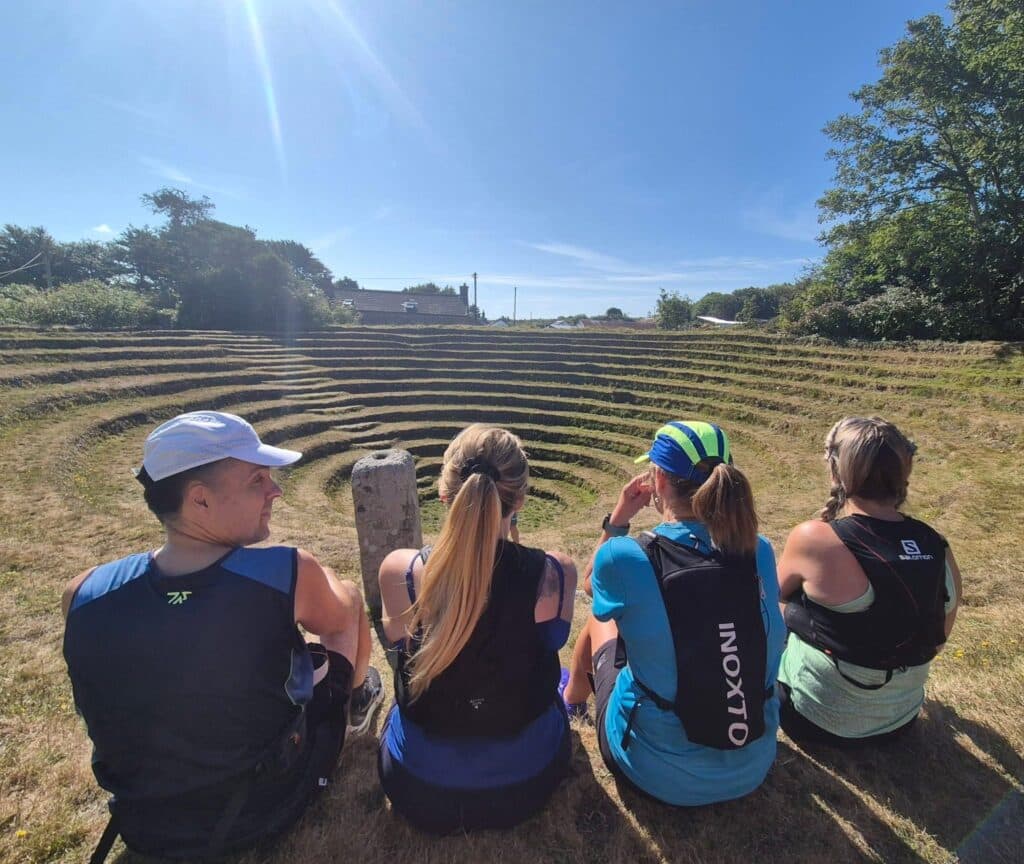
How hard should a club run feel? For most ordinary social or steady runs, the answer is controlled enough that you can talk to the people around you. You should feel that you are running, but not racing to keep your place in the group.
There are exceptions. Track sessions, hill repetitions and other structured workouts are designed to include harder efforts. Even then, every part of the evening should not feel like an all-out test.
The right effort depends on the purpose of the session, the route, the terrain and how you feel that day. Learning to judge those things is more useful than trying to match somebody else’s watch pace.
Start with the purpose of the session
Before choosing a route or setting off with a group, ask what the evening is intended to achieve. Not every club run has the same purpose.
Social and steady runs
A regular social run should normally feel sustainable. Conversation may become less fluent on a hill, but you should generally be able to speak in sentences and settle back into a comfortable rhythm afterwards.
This is not wasted training or an option reserved for slower runners. Controlled running builds consistency and gives club members of different abilities the chance to share a route without turning every Wednesday into a race.
Track, hills and speed sessions
During a structured session, individual repetitions may feel challenging. Your breathing will be stronger and you may only manage a few words while working. The recovery periods are there to let you regain control before the next effort.
Listen to the session briefing rather than copying the fastest person present. The aim is to complete the workout at an effort that is appropriate for you, not to win the first repetition and struggle through everything that follows.
Trail and away runs
Uneven ground, mud, gates, narrow paths and sustained climbs can make an off-road route feel much harder than the same distance on level roads. Pace will naturally change, and walking a steep section can be a sensible way to stay with the group and manage your effort.
Check the Carn Runners Run Schedule before attending. It shows upcoming routes, track nights, speed sessions and away runs, helping you understand what sort of evening to expect.
Use the talk test instead of chasing a number
Your watch can be useful, but pace alone does not tell you how hard you are working. Hills, wind, trail conditions, tired legs and even the flow of a group can change the effort required to run a particular speed.
England Athletics’ guidance on training pace suggests using conversation and perceived effort to judge intensity. A simple version looks like this:
- Easy effort: you can have a relaxed conversation and feel that you could continue for a good while.
- Steady effort: you are breathing more strongly but can still speak in sentences.
- Hard effort: you can manage only short answers or a few words at a time.
- Maximum effort: talking is extremely difficult and the pace can only be sustained briefly.
Most of a normal social club run should sit towards the easy or steady end. Harder effort belongs within sessions designed to include it, rather than appearing because you chose a group that is moving too quickly.
Distance is only part of the decision
It is tempting to choose a route by mileage alone, but the longest option is not always the most suitable one. Consider the whole session:
- Is the route flat, hilly or off-road?
- Are the surfaces familiar to you?
- Is it a social run or a structured workout?
- Have you already run or raced recently?
- Will darkness or poor weather make the route more demanding?
- Can you cover the distance while remaining aware of the route and group?
A hilly five miles may require more effort than a flatter six. Equally, a shorter route run too quickly can be much tougher than a longer route completed at a conversational pace.
Choose conservatively on your first few club nights
If you are new to group running, returning after a break or moving up in distance, begin with an option you are confident you can complete. You can always choose a longer or more demanding route on another evening.
Tell the run leader that you are new and explain roughly what you have been doing recently. You do not need an impressive race time or a perfectly calculated pace. Useful information might simply be that you regularly complete 5K, currently use run-walk intervals or have not run with a group before.
England Athletics’ RunTogether advice for runners recommends speaking to the leader when you are unsure about keeping up or choosing the right group. Asking before the start is far better than spending the whole run worried that you have selected the wrong option.
Good group habits make every pace work better
A club run is a shared activity rather than a collection of individual time trials. A few simple habits help the whole group enjoy the evening:
- Listen to the route and safety briefing, even if you have run there before.
- Follow any instructions about regrouping, looping back or running in single file.
- Do not disappear ahead at a junction unless you know where the group has been asked to wait.
- Warn nearby runners about potholes, roots, traffic and other hazards.
- Give pedestrians and other path users room to pass.
- Tell the leader if you need to stop or leave the session early.
- Look out for the people around you rather than assuming somebody else will do it.
Faster runners can still get a useful session without stretching the group into a long line. Where the leader asks for it, controlled looping back or regrouping adds distance while keeping everyone connected.
Signs that you may be running too hard
You may have chosen an unsuitable effort if you are racing from the beginning, cannot listen to directions, repeatedly lose contact with the group or find that every small hill becomes an all-out struggle.
There is no embarrassment in easing back, taking a short walking break or choosing a shorter route next time. A sensible adjustment usually leads to a more enjoyable evening and makes it easier to return consistently.
Remember that the right group can change from week to week. Someone who normally chooses a longer option may step down after a race, while a runner building confidence may gradually move up. Neither decision needs to be permanent.
When are you ready for a greater challenge?
You might consider a longer route or a more demanding session when your current choice feels controlled across several runs, you finish with something left and you are comfortable following the group even when the terrain changes.
Move up because you are ready for a new challenge, not because everybody around you appears to be doing more. Try one change at a time: a little more distance, a slightly stronger group or a structured speed session. You do not need to increase everything at once.
Try a Carn Runners club night
Carn Runners welcomes runners aged 16 and over, from beginners using run-walk intervals to experienced racers. Newcomers can attend up to four club nights free before deciding whether to join; details are available on the Membership Application page.
Wednesday club nights usually meet at Camborne Cricket Club at 6:30pm, although away runs are held occasionally. Check the latest schedule before travelling and browse Club News to see what members have been doing.
If you are unsure which session would suit you, use the Contact page or email hello@carnrunners.co.uk. Letting the club know you are coming also gives us the chance to welcome you and help you choose an appropriate option.