Volunteering at a running race is one of the best ways to experience an event without pinning on a number. You might guide runners around a corner, hand out water, help at registration or place a medal around somebody’s neck after months of training.
You do not need to be a fast runner—or a runner at all—to be useful. For most roles, the important things are arriving on time, listening carefully and following the organiser’s instructions. Nobody should expect a first-time volunteer to know everything before the briefing.
What jobs can race volunteers do?
A race needs much more than a start line and a stopwatch. The available jobs depend on the course and size of the event, but common roles include:
- Registration: welcoming entrants, checking names and distributing race numbers or timing chips.
- Course setup: helping place signs, cones, tape or other equipment under the direction of the event team.
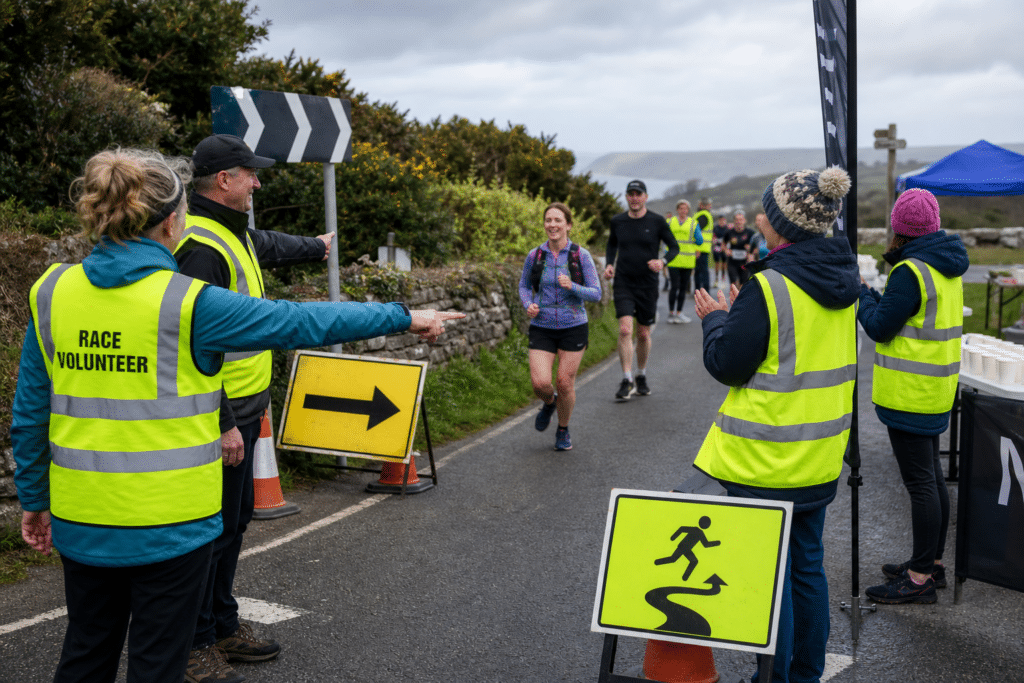
- Course marshalling: standing at an allocated point and showing runners the correct route.
- Water stations: preparing and handing out drinks while keeping the area clear.
- Start and finish support: helping runners enter the correct area, keeping finish funnels moving or directing finishers towards water and medals.
- Recording and timing support: noting numbers, completed laps or finishing positions.
- Medals and refreshments: congratulating finishers and distributing the items provided by the organiser.
These reflect the range of practical roles listed in England Athletics’ introduction to endurance officiating. Some technical or supervisory positions require training and experience, but plenty of race-day jobs are suitable for newcomers working with an established team.
Ask a few questions before race day
When you offer to volunteer, make sure you know where to report, what time to arrive and roughly when you will finish. It is also sensible to ask whether you will be outdoors for the whole event, whether seating or shelter is available and what equipment will be supplied.
If standing for a long period, walking over uneven ground or carrying equipment could be difficult, tell the volunteer coordinator in advance. Race teams usually have a variety of tasks, and early notice gives them the best chance of finding an appropriate role.
Volunteers under 18 should check the event’s age requirements and whether an accompanying adult is needed. Each organiser may have different conditions.
What should you bring?
Cornish race conditions can change quickly, especially on exposed roads, coast paths and multi-terrain courses. Even when the runners are only out for an hour, volunteers may be in position much longer.
A useful race-day kit list includes:
- comfortable footwear suitable for the ground;
- warm layers and a waterproof jacket;
- a hat, gloves or sun protection when appropriate;
- food and a drink for your own shift;
- a fully charged mobile phone;
- any written instructions sent by the organiser; and
- medication or personal essentials you normally carry.
Wear any high-visibility vest, identification or event clothing issued to you. Avoid headphones while on duty: you need to hear runners, other volunteers, traffic and radio or telephone instructions.
Listen carefully to the volunteer briefing
The briefing is not a formality. It should explain your position, the direction runners will approach from, the route they must follow and what to do if something unexpected happens.
Before going to your post, make sure you understand:
- your exact location and responsibility;
- who your team leader or main contact is;
- how to report an incident;
- where first-aid support is located;
- how you will know the final runner has passed; and
- whether you must wait for permission before leaving your position.
England Athletics’ event standards information identifies marshal briefings, communications, high-visibility clothing, medical provision and course signage as important parts of race management. If anything in your instructions is unclear, ask before the race starts.
How to be a helpful course marshal
A marshal’s first job is to help runners follow the course safely. Stand where the organiser has placed you and give clear, early directions. A confident “left turn” with an obvious arm signal is more useful than waiting until a runner reaches the junction.
Encouragement is always welcome, but give essential information first. At a busy or complicated point, runners need to hear the direction rather than a long conversation. If the course is quiet, a friendly cheer can make a real difference—particularly to runners further back in the field.
Do not change position, move signs or invent a different system because it appears more convenient. The wider event plan may depend on you remaining at that exact point.
Never step into a road or attempt to control vehicles unless this is explicitly part of an approved traffic-management role for which you have received the necessary briefing and, where required, training. England Athletics treats traffic management as a specialist area of event organisation.
What if a runner needs help?
Follow the event’s emergency procedure rather than trying to solve everything yourself. Contact the named team leader, race control or medical provider and give clear information about your location and what has happened.
Only provide first aid if you are trained, willing and acting within your competence. Otherwise, focus on contacting the designated medical team, keeping the immediate area as safe as reasonably possible and reassuring the person until help arrives.
Tell the organiser about hazards, missing signs, members of the public on the course or any other concern. A prompt, factual report is far more helpful than assuming somebody else has already noticed.
Wait until you are officially stood down
The last runner you see may not be the final person on the course. There could be a delayed participant, a second race or a sweep team still to come. Remain at your post until the agreed signal arrives or your team leader tells you to leave.
At the end of the shift, return any radio, vest, signage or other equipment. If something did not work well, share it calmly with the coordinator. Volunteer feedback can help improve the next event.
Getting involved with races in Cornwall
Carn Runners members regularly take part in events across the county, including races in the Cornwall Grand Prix and Cornwall Multi-Terrain Race Series. Volunteering offers another way to support local running, learn how races work and enjoy the atmosphere when you are not competing.
Keep an eye on Carn Runners Club News and club messages for volunteer requests. Always respond through the contact method given by the organiser rather than simply arriving on race day, as roles and access arrangements need to be planned in advance.
Run, volunteer and become part of the club
If you would also like to run with Carn Runners, Wednesday club nights normally meet at Camborne Cricket Club at 6:30pm. Check the latest Run Schedule before travelling, as occasional away runs and special sessions may change the meeting arrangements.
Newcomers aged 16 and over can attend up to four free club nights before deciding whether to join. Visit the Membership Application page for details, or use the Contact page and email hello@carnrunners.co.uk if you have a question about running or volunteering with the club community.